

Paradise Lost (part 3)
Book 1, Lines 84-124

This is Lucifer's first monologue. He and his army have been newly cast from heaven - “nine times the space that measures day and night.” They've fallen a considerable distance and wake up to realize that not only are they in a foreign, dark, and dismal place, they, themselves look different. Lucifer wakes up on the lake of fire and looks over to his best mate, Beelzebub. This speech is wracked with pain and grief and confusion, yet Satan, still stubborn and determined to get his revenge, skillfully manipulates Beelzebub, while also attempting to convince himself that they only lost because God cheated and therefore they still deserve the win. Lucifer's first speech is a powerful introduction to Milton's Satan and to the reason why this poem was banned by the Catholic Church.
Additionally, you'll notice that the illustrations are often a different artist's interpretation of the same line or passage as the previous illustration. Several artists recreated earlier illustrations, such as this one by John Martin who reimagined Gustave Dorè’s earlier interpretation of the same line.
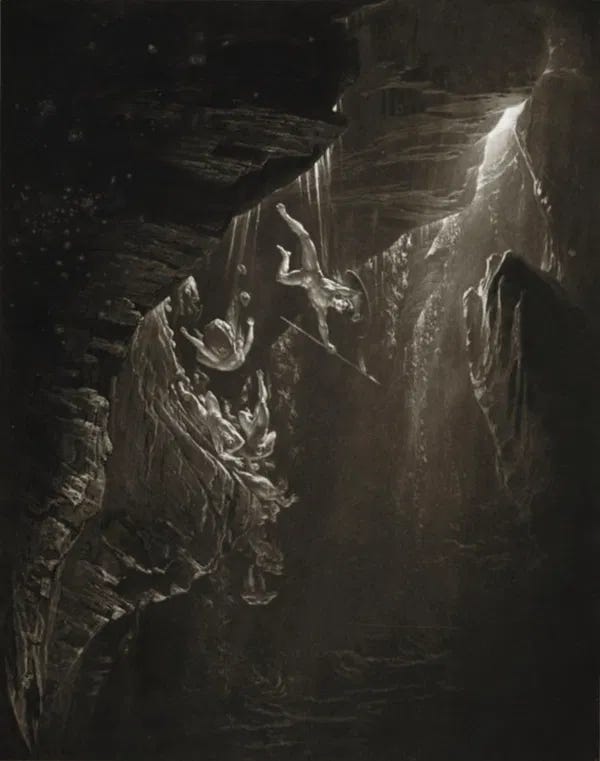
John Martin, 1824. Book 1, Line 44
Him the Almighty Power Hurled headlong flaming from the ethereal sky.
I urge you with every ounce of my being to please consider reading this out loud.
Book 1, Lines 84-124
If thou beest he; But O how fall'n! how chang'd
From him, who in the happy Realms of Light [ 85 ]
Cloth'd with transcendent brightness didst out-shine
Myriads though bright: If he Whom mutual league,
United thoughts and counsels, equal hope
And hazard in the Glorious Enterprize,
Joynd with me once, now misery hath joynd [ 90 ]
In equal ruin: into what Pit thou seest
From what highth fall'n, so much the stronger prov'd
He with his Thunder: and till then who knew
The force of those dire Arms? yet not for those,
Nor what the Potent Victor in his rage [ 95 ]
Can else inflict, do I repent or change,
Though chang'd in outward lustre; that fixt mind
And high disdain, from sence of injur'd merit,
That with the mightiest rais'd me to contend,
And to the fierce contention brought along [ 100 ]
Innumerable force of Spirits arm'd
That durst dislike his reign, and me preferring,
His utmost power with adverse power oppos'd
In dubious Battel on the Plains of Heav'n,
And shook his throne. What though the field be lost? [ 105 ]
All is not lost; the unconquerable Will,
And study of revenge, immortal hate,
And courage never to submit or yield:
And what is else not to be overcome?
That Glory never shall his wrath or might [ 110 ]
Extort from me. To bow and sue for grace
With suppliant knee, and deifie his power,
Who from the terrour of this Arm so late
Doubted his Empire, that were low indeed,
That were an ignominy and shame beneath [ 115 ]
This downfall; since by Fate the strength of Gods
And this Empyreal substance cannot fail,
Since through experience of this great event
In Arms not worse, in foresight much advanc't,
We may with more successful hope resolve [ 120 ]
To wage by force or guile eternal Warr
Irreconcileable, to our grand Foe,
Who now triumphs, and in th' excess of joy
Sole reigning holds the Tyranny of Heav'n.
Despite being utterly defeated, Lucifer refuses to admit defeat. He insists that he regrets nothing. This defiance sets the stage for his actions in the rest of book one, but it also defines him and introduces his core philosophy: he believes his identity is based on his will, and not his status. He commends the fallen angels and urges them that even though they have lost the battle, they have lost heaven, and they have lost their own luster and brilliance, all is not lost because they still have their will. They have not lost the ability to choose, and that, above all else, should be seen as a win.
Milton was revolutionary in his depiction of Lucifer as intelligent, cunning, eloquent, and ever defiant. Lucifer's choice was pure and noble, but now defeat turns into delusion as he masterfully reframes the battle. He vows revenge, and in doing so he forever imprisons himself. Ironically, choosing freedom ends up meaning he can never be free.