

Paradise Lost (part 5)
Book 1, Lines 156-191

So far we've had one monologue from Lucifer and one from Beelzebub, both intense introductions to their characters and philosophies. We've seen Lucifer as a still defiant commander, unwilling to accept defeat, while his second in command, Beelzebub, stays calm and rational in the face of an unimaginable loss. Beelzebub is loyal and supportive of his leader to the end, although he sees the defeat differently from Lucifer. At this point, Beelzebub has just realized that hell means existence without joy for all eternity, and he postulates that God is intentionally cruel.
This passage picks up as Beelzebub finishes his monologue. It is one of Lucifer's most painfully and tragically eloquent monologues. In it, Satan lays out his entire philosophy and future plans to his mate, Beelzebub. He is strong, intelligent, commanding and catastrophically deceiving himself. Milton presents him as ideologically bent on an eternity of revenge, completely missing the irony of his own self imprisonment.
Incidentally, I'm so I'm love with this poem that I have the entire first book memorized. When you read this passage, I encourage you to read it out loud. It's meant to be shouted. 😁
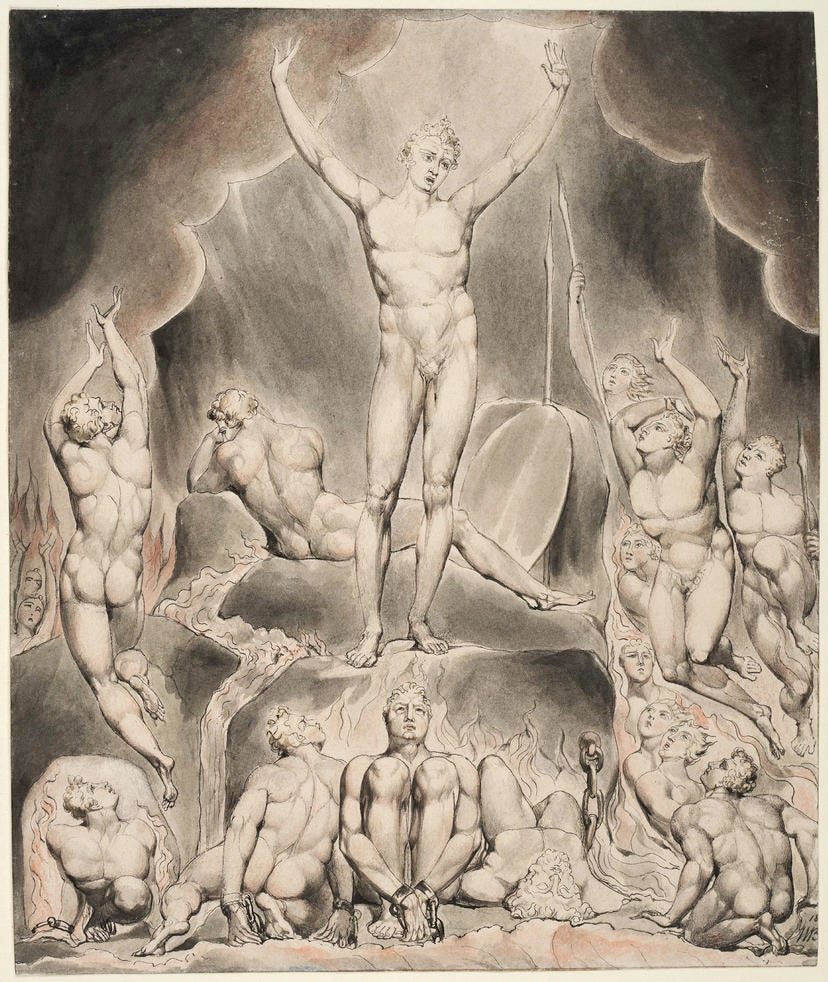
William Blake created three separate sets of illustrations for Paradise Lost, and they are all slightly different. It's difficult to track down all of them, but I will be labeling the ones I can find with the name of the owner of the set. This one is from the Thomas set.
Book 1, Lines 156-191
Whereto with speedy words th' Arch-fiend reply'd.
Fall'n Cherube, to be weak is miserable
Doing or Suffering: but of this be sure,
To do ought good never will be our task,
But ever to do ill our sole delight, [ 160 ]
As being the contrary to his high will
Whom we resist. If then his Providence
Out of our evil seek to bring forth good,
Our labour must be to pervert that end,
And out of good still to find means of evil; [ 165 ]
Which oft times may succeed, so as perhaps
Shall grieve him, if I fail not, and disturb
His inmost counsels from thir destind aim.
But see the angry Victor hath recall'd
His Ministers of vengeance and pursuit [ 170 ]
Back to the Gates of Heav'n: The Sulphurous Hail
Shot after us in storm, oreblown hath laid
The fiery Surge, that from the Precipice
Of Heav'n receiv'd us falling, and the Thunder,
Wing'd with red Lightning and impetuous rage, [ 175 ]
Perhaps hath spent his shafts, and ceases now
To bellow through the vast and boundless Deep.
Let us not slip th' occasion, whether scorn,
Or satiate fury yield it from our Foe.
Seest thou yon dreary Plain, forlorn and wilde,[ 180 ]
The seat of desolation, voyd of light,
Save what the glimmering of these livid flames
Casts pale and dreadful? Thither let us tend
From off the tossing of these fiery waves,
There rest, if any rest can harbour there, [ 185 ]
And reassembling our afflicted Powers,
Consult how we may henceforth most offend
Our Enemy, our own loss how repair,
How overcome this dire Calamity,
What reinforcement we may gain from Hope, [ 190 ]
If not what resolution from despare.
Lucifer finishes this speech, defining himself, as well as the fallen angels, as Evil itself. They will do evil just for the sake of doing evil, and if God should try to find good in spite of that, their entire existence will be to pervert that end. At this point he notices that God ‘s armies have stopped pursuing them and he prepares to rally his troops on the battlefield of hell where they will reassemble and discuss how best to continue. He finishes by admitting that while hope may be impossible, they will never surrender.